
How Do You Know Which Treatment Is Right for You?
Anyone who has spent time scrolling through skincare and aesthetic content online has probably felt this exact kind of overwhelm. One article says fillers are the answer, another swears by lasers, a friend just tried threads, and somewhere in the mix you are still not entirely sure what is actually causing the thing that bothers you in the first place. Is it volume loss, sagging skin, sun damage, or some combination of all three? And even if you knew, would you know which treatment actually addresses it?
This is exactly the gap an aesthetic consultation is meant to close, and it is one of the most underrated first steps in the entire process of improving your skin.
Why Is It So Hard to Know Which Treatment You Need?
Skin concerns rarely show up labeled. A line near the mouth could be caused by volume loss, by repeated movement, by sun damage, or by some combination of the three, and each of those causes points toward a different treatment. Without a trained eye, it is easy to guess wrong, spend money on the wrong service, and end up feeling like nothing worked, when really the issue was simply a mismatched treatment.
What Are the Most Common Concerns People Bring to a Consultation?
Patients typically come in with one or more of the following:
- Fine lines and wrinkles they are not sure how to categorize
- Volume loss that makes the face look flatter or more tired
- Sagging or loose skin along the jaw, cheeks, or neck
- Sun damage, uneven tone, or texture concerns
- Persistent acne or acne scarring
- Unwanted hair
- General uncertainty about where to even start
Any one of these could point toward several different services, which is exactly why guessing on your own so often leads to disappointing results.
What Actually Happens During an Aesthetic Consultation?
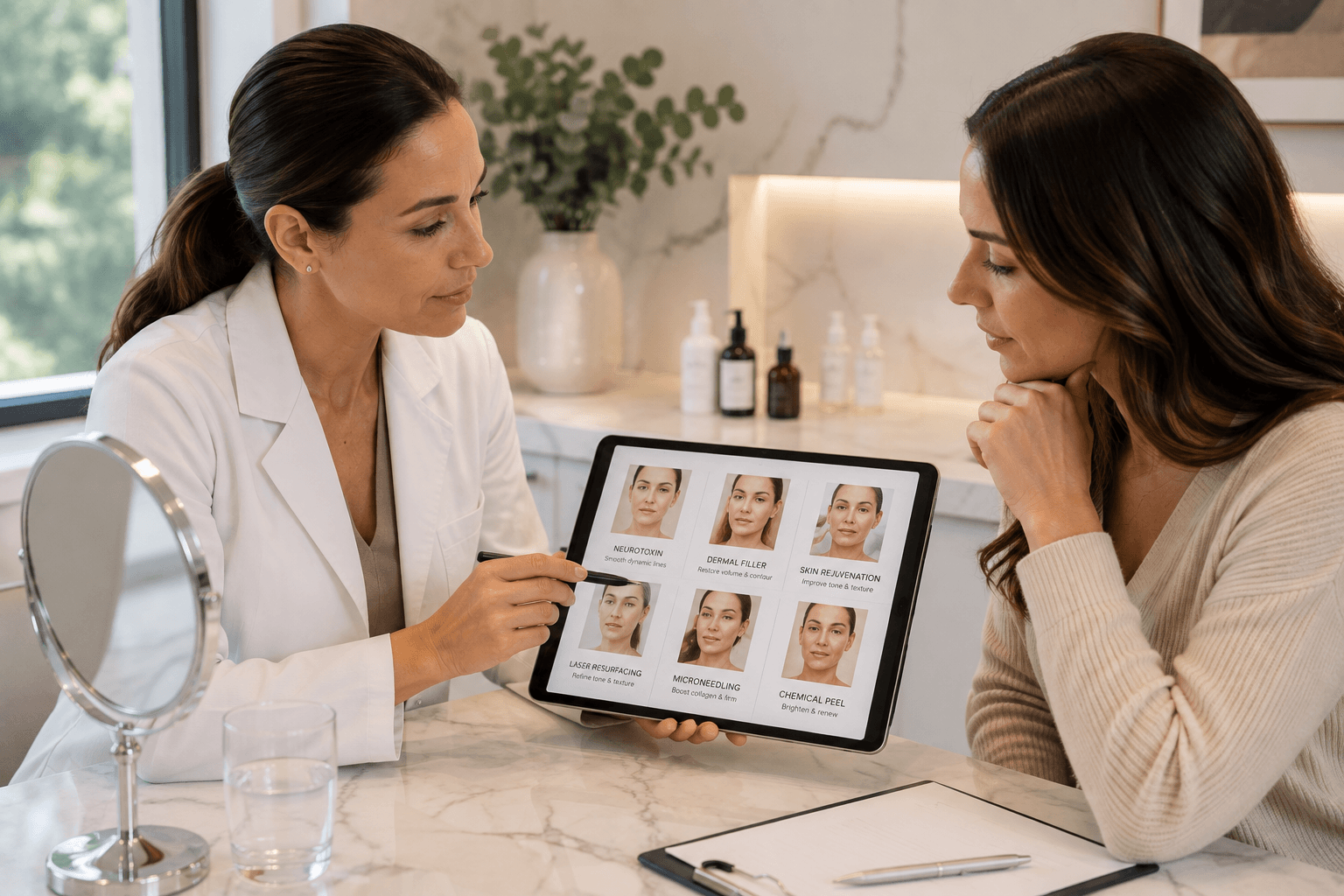
An aesthetic consultation at AESHA Medical Aesthetics starts with a conversation, not a sales pitch. A provider will ask about your history, your goals, and what specifically bothers you, then take a closer look at your skin, sometimes supported by tools like skin analysis technology that can reveal concerns not always visible to the naked eye.
Why Does a Skin Analysis Matter?
A lot of skin concerns exist below the surface before they become visible, including early sun damage, early collagen breakdown, or uneven pigmentation patterns that have not fully surfaced yet. A proper analysis gives a provider a much clearer picture of what is actually happening in your skin, which leads to a more accurate treatment recommendation instead of a generic one.
How Does a Provider Decide Which Treatment to Recommend?
This comes down to matching the cause of your concern to the treatment designed to address it. For example, someone dealing primarily with volume loss might be steered toward Sculptra or dermal fillers, while someone with sagging skin and good elasticity might be a better fit for threads. Someone dealing with texture and tone issues might be better served by a resurfacing treatment like Moxi or a Micro Laser Peel, while unwanted hair points toward laser hair removal entirely. None of these decisions should be made from a menu alone. They should be made based on your specific skin.
Why Should You Get a Consultation Before Booking a Specific Treatment?
It is tempting to skip straight to booking whatever treatment a friend raved about or an ad convinced you to try. The problem is that what worked beautifully for someone else's skin concern might not address yours at all, even if the symptoms look similar on the surface.
What Happens If You Skip the Consultation Step?
Without a proper assessment, there is a real risk of spending time and money on a treatment that was never designed to solve your specific concern. Someone with volume loss who books a treatment meant for surface texture, for instance, might be disappointed by results that were never going to address the actual cause. A consultation exists specifically to prevent that kind of mismatch.
Who Should Get an Aesthetic Consultation?
Honestly, almost anyone considering aesthetic treatment for the first time, and even people who have had treatments before but are considering something new. It is also a smart step for patients who are simply unsure where to start, since a consultation does not obligate you to book anything specific afterward. It is meant to give you clarity, whether that leads to a treatment plan right away or just a better understanding of your options for the future.
Is a Consultation Only for Injectables and Lasers?
Not at all. Many patients use a consultation, or a related wellness consultation, to talk through broader concerns like fatigue, weight management, or overall wellness goals, which can sometimes tie into services like functional medicine or weight loss injections. Aesthetics and overall wellness are more connected than a lot of people realize.
What Should You Bring or Ask About During Your Consultation?
A good consultation is a two-way conversation. It helps to come prepared with a general sense of what bothers you most, even if you are not sure of the technical cause, along with any relevant medical history and current skincare routine. It is also worth asking directly about expected downtime, realistic timelines for results, and cost, so there are no surprises once you move forward with a plan.
How Often Should You Revisit a Consultation?
Skin changes over time, and so do treatment technologies. Many patients benefit from checking back in periodically, especially if their goals shift or if they are considering a new treatment they have not tried before. This is particularly true as you move through different solutions by age, since what your skin needs in your thirties is not necessarily what it will need a decade later.
Frequently Asked Questions
Is an aesthetic consultation free? This varies by practice, so it is worth confirming directly, but many clinics offer a consultation as a low-pressure first step specifically so patients can get informed guidance before spending on a treatment.
Do I have to book a treatment after my consultation? No. A consultation is meant to give you clarity and options, not to obligate you to a specific service.
How long does an aesthetic consultation take? Most consultations take somewhere between twenty and forty-five minutes, depending on how many concerns you want to discuss and whether skin analysis technology is used.
What should I avoid before my consultation? It generally helps to arrive with minimal makeup so your provider can get a clear, accurate view of your skin.
Can a consultation help if I am not sure what is bothering me? Yes. In fact, that is one of the most common reasons patients book one. A provider can help identify the specific concern behind a general feeling that "something looks off."
Consider This Your Cheat Sheet (Minus the Guesswork)
Trying to self-diagnose your skin from articles and social media is a bit like trying to fix a car engine based on a few videos, you might land on the right answer, but you are just as likely to spend money fixing the wrong thing. An aesthetic consultation takes the guesswork out of the equation, matching your actual concern to a treatment that is actually designed to address it.
If you have been unsure where to start, the team at AESHA Medical Aesthetics can walk you through a consultation built around your skin, your goals, and your budget, with zero pressure to book anything you are not ready for.
This article was updated in August 2026 to reflect current consultation practices and local Jacksonville insights.